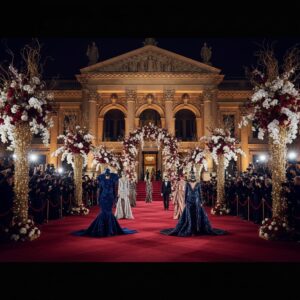
Few cultural spectacles command the world’s attention quite like the red carpet. These stretched velvet strips — at the Oscars, the Met Gala, Cannes, and beyond — have given us some of the most indelible iconic red carpet moments in modern memory. A single outfit worn for fewer than three hours can dominate global conversation for decades, shape careers, and redefine what fashion is capable of saying. This is the story of those looks, the eras they belong to, and why they still matter.
Why the Red Carpet Became a Cultural Stage
The red carpet did not always mean what it means today. For most of Hollywood’s Golden Age, stars dressed for film premieres with elegance but little fanfare. It was the explosion of televised awards ceremonies in the 1980s and 1990s — and the rise of 24-hour entertainment media — that transformed the arrivals sequence into its own event. By the mid-1990s, Joan Rivers’ pre-show interviews had turned fashion into sport, complete with winners, losers, and instant replays.
The internet accelerated everything. A 2004 outfit that might once have lived only in a magazine spread now lives forever in high resolution, searchable and shareable. That permanence changed how designers, stylists, and stars approached the red carpet entirely — and it’s why certain looks from the past two decades feel as fresh today as the morning after they first appeared.
Explore the full visual history in our celebrity photos hub, and follow the latest arrivals in the red carpet category.
The Met Gala: Fashion’s Most Theatrical Night
If the Oscars is the establishment, the Met Gala is the avant-garde — a benefit for the Metropolitan Museum of Art’s Costume Institute in New York that operates under an annual theme, demanding interpretation, creativity, and occasionally outright spectacle. It is the event most likely to produce a look that transcends fashion and enters the broader cultural conversation.
Rihanna and the Yellow Gown That Redefined Arrival
Few entrances in Met Gala history rival Rihanna‘s 2015 appearance in a sweeping yellow cape gown by Chinese designer Guo Pei. The piece — reportedly taking thousands of hours to hand-embroider and weighing a significant amount — required careful choreography just to get through the door. The image of Rihanna at the top of those stone steps, the cape fanning behind her like a sunrise, immediately became one of the most reproduced fashion photographs of the decade.
What made it iconic was not just the scale but the context. The 2015 theme was “China: Through the Looking Glass,” and rather than defaulting to Western designers’ interpretations of Chinese aesthetics, Rihanna wore an actual Chinese couturier. The choice was widely noted as one of the most culturally coherent looks of the night — and arguably of any Met Gala.
Zendaya and the Art of the Thematic Deep Dive
If there is a contemporary master of Met Gala dressing, it is Zendaya. Year after year, working closely with her longtime stylist Law Roach, she has delivered looks that go beyond beautiful clothing and into genuine conceptual fashion. For the “Heavenly Bodies” theme she arrived as a Joan of Arc figure in full armored chainmail by Versace. For “Camp: Notes on Fashion” she channeled Cinderella with a light-up Tommie Hilfiger gown. Each look demonstrates an engagement with the theme that many guests with far longer fashion CVs rarely achieve.
Zendaya’s approach has made her a studied example in fashion schools and editorial circles: the idea that red carpet dressing is not just about wearing beautiful clothes, but about telling a story.
The Oscars: Glamour, Gravity, and Game-Changing Moments
The Academy Awards red carpet operates under a different register than the Met Gala. The Oscars skew toward classical glamour — long gowns, significant jewels, studied elegance. But within that framework, certain moments have broken the mold completely.
Björk’s Swan Dress: Defiant and Defining
When Björk arrived at the 2001 Academy Awards in a white dress shaped like a swan — complete with the bird’s neck and head draped over one shoulder — she divided opinion instantly. Fashion critics and late-night hosts spent weeks mocking it. And yet the swan dress has endured as one of the most discussed pieces of clothing ever worn on a red carpet. Marjan Pejoski, the Macedonian designer behind the gown, became internationally known overnight. The dress is now in museum collections and is cited regularly as a landmark moment when celebrity fashion stopped being purely aspirational and became genuinely provocative.
The Power of the Classic: Audrey, Grace, and the Blueprint
Before the era of stylist-orchestrated moments, the Oscars red carpet was shaped by stars whose personal style was inseparable from their public image. Audrey Hepburn’s relationship with Givenchy, Grace Kelly’s understated precision, Elizabeth Taylor’s appetite for diamonds and drama — these were not curated strategies but expressions of genuine personal taste that happened to photograph magnificently. They established the template that every red carpet since has either honored or consciously rejected.
Cannes: European Glamour and Global Reach
The Cannes Film Festival red carpet has its own grammar. The Palais des Festivals staircase demands a certain theatrical quality — the long climb, the photographers banked on either side, the blazing Mediterranean light. Cannes has a tradition of pure cinematic glamour that the Oscars sometimes trades for industry formality.
The Looks That Defined the Croisette
- Sophia Loren at various Cannes ceremonies — the original definition of Italian cinematic glamour, setting a standard of confident sensuality that influenced decades of red carpet dressing.
- Lupita Nyong’o — her consistent presence on international red carpets, including Cannes, introduced a new vocabulary of African-influenced design to the highest levels of fashion coverage.
- Eva Longoria — a fixture of the Cannes carpet who has used the event to champion Latin American designers at an international showcase.
- Cate Blanchett — repeatedly cited in best-dressed lists for her commitment to architectural shapes and willingness to wear avant-garde designers in an environment that rewards conventional glamour.
Themes and Eras: How Red Carpet Fashion Evolved
Looking across the full arc of red carpet history, several distinct eras emerge.
The 1990s: Minimalism and the Slip Dress Revolution
The 1990s red carpet was dominated by minimalism — bias-cut slip dresses, muted palettes, and the studied cool of designers like Calvin Klein and Jil Sander. Gwyneth Paltrow’s blush Ralph Lauren tuxedo at the 1999 Oscars, Carolyn Bessette-Kennedy’s white column gown at her own wedding broadcast to millions, and the general aesthetic of effortless understatement defined the decade’s red carpet language.
The 2000s: Maximum Impact
The 2000s reacted against 1990s minimalism with volume, color, and showmanship. J.Lo’s plunging Versace jungle print dress at the 2000 Grammy Awards became one of the most searched images in Google’s early history — reportedly prompting the creation of Google Images. The 2000s established that red carpet fashion could generate genuine commercial and cultural impact beyond the night itself.
The 2010s and Beyond: The Stylist Era
The rise of the power stylist — Law Roach, Kate Young, Elizabeth Stewart, Wayman + Micah — transformed red carpet dressing from personal expression into collaborative creative strategy. Stylists now operate as creative directors of a celebrity’s public fashion identity, building long-term narratives across multiple seasons. The best stylist-star partnerships produce looks that feel both inevitable and surprising: exactly right for the person, exactly right for the moment.
The Business of Iconic Moments
Behind every memorable look is a commercial ecosystem. Designers compete fiercely for the opportunity to dress high-profile attendees, knowing that a single widely-photographed gown can generate press coverage worth millions in advertising equivalent. Jewelers lend extraordinary pieces — necklaces, rings, and earrings that retail for more than most homes — for a few hours on the theory that the images will circulate for years.
- Designer fees and loans — major houses typically provide gowns at no charge in exchange for the exposure; custom pieces may involve weeks of fittings and significant production cost borne by the brand.
- Jewelry insurance — borrowed high jewels require extensive security arrangements and are insured for their full replacement value during transit and wearing.
- The social media multiplier — a look posted by a star with tens of millions of followers reaches an audience that no traditional media placement can match, making the red carpet one of the most efficient marketing channels in luxury fashion.
What Makes a Moment Truly Iconic?
Not every celebrated outfit becomes truly iconic. The looks that endure tend to share a handful of qualities: they are photographically arresting from every angle, they feel right for the person wearing them, they register a cultural shift or make a cultural argument, and they are slightly ahead of where fashion was at that moment. The best red carpet moments are not just beautiful — they are prescient.
They also tend to be slightly risky. The safe choices — the tried-and-true silhouettes in conventional palettes — are rarely the ones anyone remembers. The looks that last are the ones that required someone, somewhere, to say yes to something that could have easily been a no.
Frequently Asked Questions
What is considered the most iconic red carpet look of all time?
There is no single consensus, but a handful of looks appear on virtually every list: Rihanna’s Guo Pei yellow gown at the 2015 Met Gala, Björk’s swan dress at the 2001 Oscars, and J.Lo’s Versace jungle print at the 2000 Grammys are among the most widely cited. Each resonated beyond fashion into broader cultural conversation.
What makes a red carpet moment iconic versus just memorable?
Iconic moments tend to capture something larger than fashion: a cultural shift, a bold personal statement, a designer’s emergence, or a defining image of a particular era. They circulate long after the event and continue to generate discussion across generations of fashion followers.
Which events produce the most iconic red carpet fashion?
The Met Gala, the Academy Awards, and the Cannes Film Festival consistently produce the most discussed looks. The Met Gala’s thematic structure encourages the most creative risk-taking; the Oscars reward classical glamour; Cannes blends cinematic drama with European luxury fashion sensibility.
How do stylists contribute to creating iconic looks?
Stylists are creative strategists who build long-term fashion narratives for their clients. They negotiate with designers, source pieces from archives, and orchestrate the complete visual package — clothing, accessories, hair, and makeup — around a coherent vision. The most celebrated celebrity-stylist partnerships produce looks that feel both surprising and entirely characteristic of the person wearing them.
Are iconic red carpet looks planned well in advance?
Major looks typically involve months of planning. Custom pieces require multiple fittings over several weeks. Even looks that appear spontaneous or effortless are usually the result of careful coordination between the celebrity, their stylist, the designer’s atelier, and the jewelry house. The appearance of effortlessness is itself part of the craft.
The Legacy of the Red Carpet
The red carpet endures because it serves a function no other cultural ritual quite replicates: it is the moment when cinema, music, celebrity, and fashion converge in a single, highly compressed spectacle. The iconic moments it produces are not accidents. They are the result of creative ambition, commercial calculation, and the rare alignment of the right person, the right garment, and the right cultural moment. That alchemy, when it works, produces images that outlast the careers they were meant to support — and that is what makes the red carpet worth watching.